What Everyone Gets Wrong About Netflix, Warner Bros., and the Value of Art
How my love for Steve Ross’s Warner Bros. shaped the way I see this entire conversation about art and value.

I was reading Scott Galloway’s latest newsletter about the Netflix–Warner Bros. deal this morning, and it reminded me of how many people still react emotionally to these things rather than looking at the actual history or economics. The panic, the doom posts, the “Hollywood is dead” take, as none of it reflects reality.
Warner Bros. has changed hands multiple times over the last several decades. This isn’t new. This isn’t shocking. Warner went from Warner Communications to Time Warner, then to AOL Time Warner, then to AT&T’s WarnerMedia, then to Warner Bros. Discovery. Now Netflix has agreed to buy the studio and streaming businesses, not the linear networks, in a deal valuing the operation at about $82.7 billion in enterprise value, with $72 billion in equity value. This is just the latest chapter in a company whose ownership has been in motion since the 1960s.
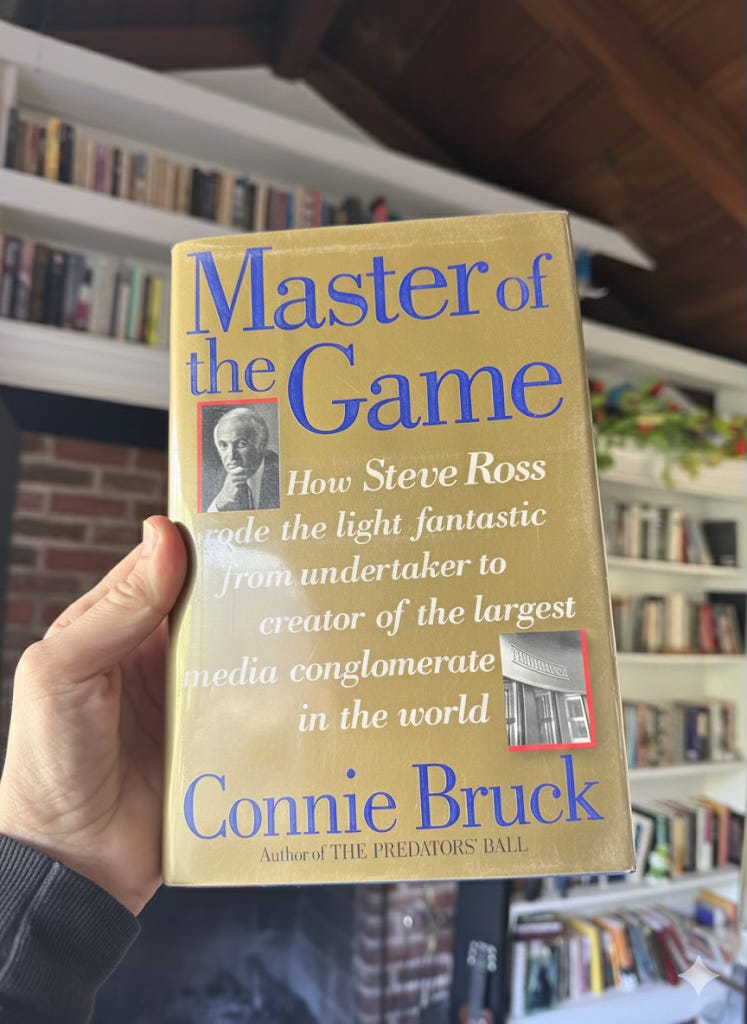
My north star for understanding Warner Bros.—and how a corporate leader can actually champion artists.
And on a personal level, I’ve always had a soft spot for Warner Bros, especially the Warner Bros. that Steve Ross built after Kinney International, a company that literally started with parking lots and funeral homes, acquired the studio in the late ’60s. Ross was one of the rare corporate leaders who understood something that’s almost extinct today: if you want great art, you have to trust the artists. The stories about him are legendary, how he backed his executives, protected his creatives, embraced their “weird, wacky” instincts, and let them pursue the ideas that made no sense until they suddenly made all the sense in the world. Under Ross, Warner wasn’t just a studio; it was a culture. A place where risk-taking was expected, where failures were the cost of boldness, and where executives weren’t punished for having taste. Some of the most important films and albums of the 20th century emerged from that philosophy. It proved something people forget: a corporate parent can be powerful and incredibly supportive of creators. That shaped my fondness for this business more than anything else.
And if you want proof that the value of Warner Bros. is even higher than people assumed, look at what happened the moment Netflix made its move: Paramount Skydance fired back with a hostile counteroffer — an all-cash $108.4 billion bid at $30 per share, and that includes the linear networks in addition to the studios and streaming. This isn’t a separate story. This is the counteroffer to the Netflix deal, a direct competitive escalation. Two major players are now fighting to control Warner Bros., and the price keeps climbing. If this studio were “dying,” nobody would be dropping nine-figure checks overnight just to outbid someone else. The market is telling you these assets are worth more, not less.
And before anyone jumps to, “Well, Netflix is more efficient, so they’re going to slash everything,” let’s get something straight:
Efficiency doesn’t kill creativity; it funds it.
People don’t seem to understand what inefficiency actually does to a studio. Every bloated layer, every redundant division, every outdated operational structure is basically a tax on the creative pipeline. It’s money not going to slates, writers’ rooms, development, animation, worldbuilding, international originals, the things that actually generate cultural and financial value.
When a company like Netflix takes over, they’re not just “cutting.” They’re removing friction between capital and creativity. That’s it. When you spend less on the machine, you can feed more into the art.
And the timing matters, because we’re living in the first era of human history where people are consuming more narrative content than ever before, not just movies and TV, but streaming, animation, shorts, docs, games, franchise storytelling, mobile-first originals, international co-productions.
The demand for content hasn’t shrunk; it’s exploded.
Streaming platforms burn through content like my favorite plane from Top Gun, The F-14, burns through jet fuel. They cannot afford to slow output.
So what does efficiency actually accomplish?
• It lowers the break-even point, which makes risk-taking possible again.
• It frees up capital that bloated orgs were wasting.
• It enables more volume, not less, because the machine is cheaper to run.
• It makes experimentation viable, because a flop doesn’t collapse the structure.
• It strengthens IP investment, because money flows to worlds that scale.
Efficiency is not austerity.
Efficiency is the precondition for creative expansion.
Netflix didn’t spend $72 billion to make fewer things.
They spent it to own the future of global storytelling, and to widen the pipeline, not shrink it.
And here’s the part people forget: every time Warner gets bought, the art survives. The catalogs survive. The creators survive. The company reinvents itself. That’s been true for more than fifty years.
So let’s ask something obvious: if you’re Netflix, a company worth roughly $425–$445 billion, and you can spend $72 billion (about 15–17% of your market cap) to lock down DC, Harry Potter, Lord of the Rings, Game of Thrones, The Sopranos, plus a film studio that still knows how to deliver billion-dollar franchises, why wouldn’t you do that? You’re not just buying a business. You’re buying cultural gravity.
People also seem to have very short memories. Earlier this year, WBD was trading at about $10. Nobody wanted it. People were writing obituaries. Then Paramount showed interest, Netflix stepped in, and suddenly everyone remembered this thing has value. Netflix offers $27.75 per share, nearly a 180% premium, and within days, Paramount escalates its bid to over $100 billion. That’s not the death of art. That’s the market rediscovering what this art is worth.
And this is where Galloway’s point lands: human nature drives markets. Demand, competition, and FOMO reprice things faster than logic ever will. You get a bidding war, and the value resets instantly.
Now, Galloway is entirely right about one thing: post-merger consolidation usually leads to fewer theatrical releases. Disney–Fox is the example, output dropped roughly 44%. And Netflix’s revenue per employee is more than double WBD’s, which means layoffs are likely. Fewer bidders for top talent also means downward pressure on wages. Those are real, structural issues.
But this idea that Netflix's acquisition of Warner is somehow the death of creativity misunderstands where creative output actually comes from. It doesn’t come from inefficient org charts. It comes from capital, demand, and the global appetite for storytelling. And all three of those are going nowhere but up.
Warner has been valued at $85B, $43B, $30B, and now $82.7B depending on the cycle. The constant is the art. The constant is the IP. The constant is demand.
So if someone thinks this deal is “bad for storytelling,” I honestly don’t know what conversation they’re having. Either update your understanding of how modern entertainment works, rethink what you believe the value of art actually is, or maybe step out of the discourse.
Two companies with a long history of supporting filmmakers made a massive, strategic, long-term bet on the industry's creative future. I can only see this as being great for the movie business.